Designing Microwave-Active Ceramic Composites
Building the materials foundation for microwave-powered water extraction from lunar regolith.
This was my graduate research thesis at Georgia Tech, completed in 2022. I left the PhD before finishing (founded Lumindt instead), but this was originally scoped as doctoral research in support of NASA's Artemis missions. I'll walk through the key findings here, but if you want the full study with methods, data, and simulations, you can read the whole thing here.
One of the harder problems with long-duration lunar missions is water. You can't ship it from Earth at scale. It's too heavy, too expensive, and completely impractical for anything beyond a short stay. This is a big part of why NASA's Artemis base camp is planned for the lunar south pole. The craters there are permanently shadowed, which means temperatures inside them drop low enough to preserve water ice that has been accumulating for billions of years. The plan is to set up on a nearby sunlit ridge for solar power, and send crews into those craters to access the ice. But first you have to get it out of the regolith.
One approach is microwave heating. Blast the regolith with microwave energy, vaporize the ice, collect the steam. No moving parts, electrically powered, scalable. The catch is that microwave energy doesn't heat everything equally. Materials absorb it based on their electrical and dielectric properties. That's where ceramic composites come in.
My thesis asked: can we engineer a composite that absorbs microwave energy efficiently enough to do real heating work? And can we predict and tune that behavior by understanding how the material's electrical properties shift with composition?
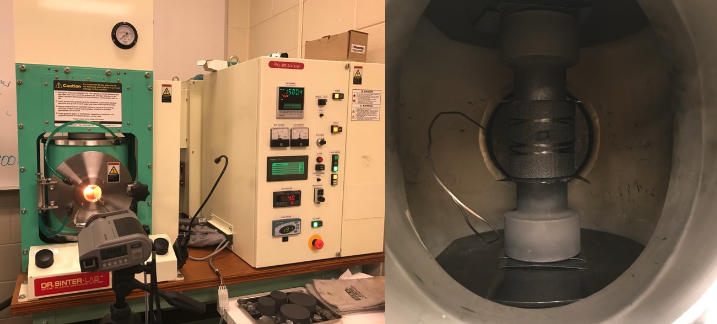
I fabricated a series of silicon carbide whisker / alumina (SiCw-Al₂O₃) composites using spark plasma sintering (SPS), a technique that densifies ceramic powders into solid discs using electrical current and pressure, in minutes rather than hours.
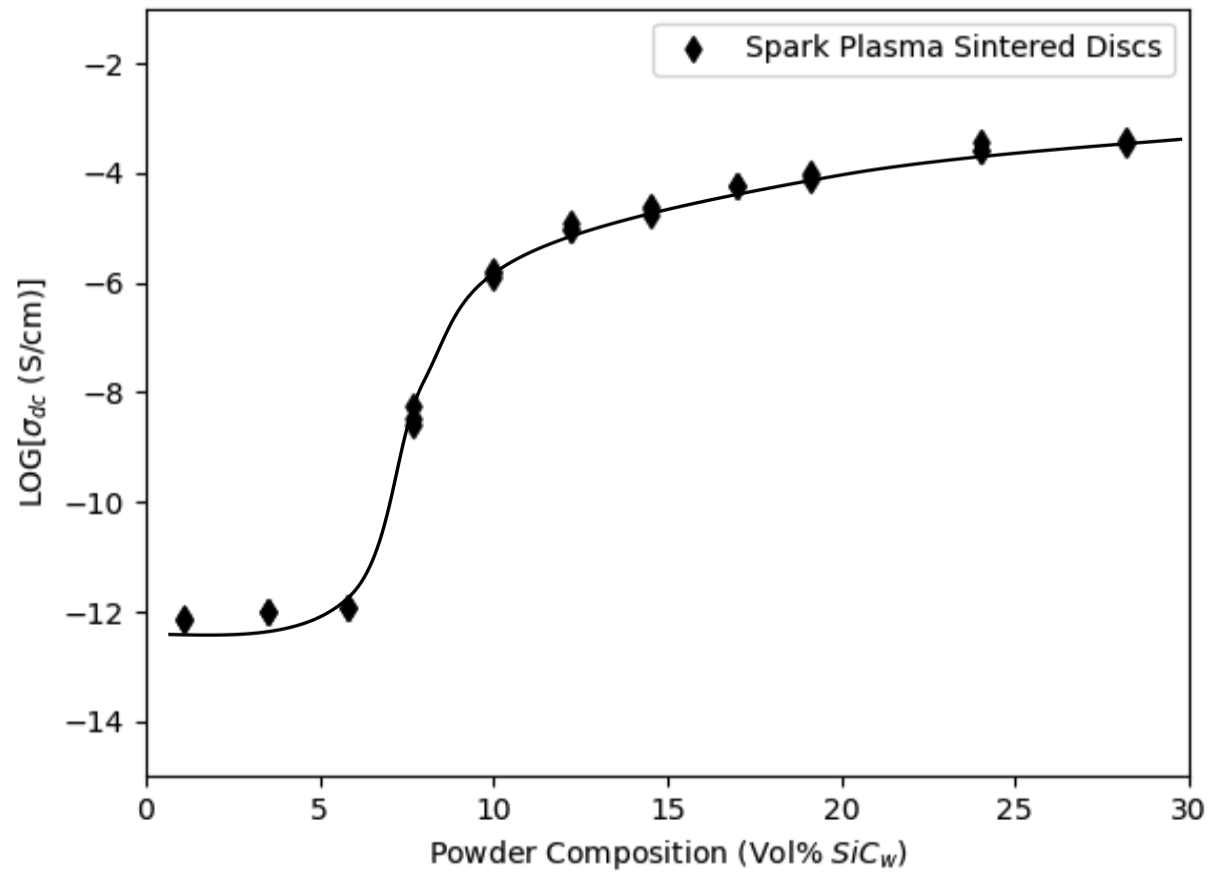
SiC is a semiconductor, so at low concentrations the composite behaves like an insulator. As you increase the whisker content, the SiC particles start forming connected pathways through the material and conductivity jumps by orders of magnitude. This is the percolation threshold, and knowing where it falls tells you a lot about how the composite will respond to a microwave.
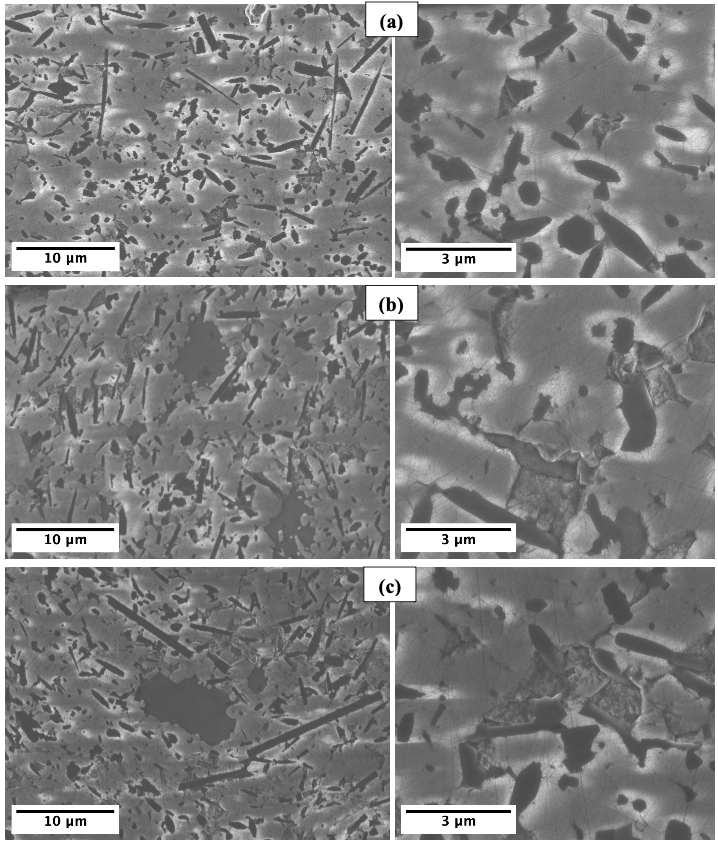
I measured the electrical behavior of each composition using impedance spectroscopy, characterized microstructure with optical microscopy and SEM, then ran COMSOL simulations to model microwave heating at 2.45 GHz and 1000W. Standard microwave frequency at a realistic power level.
In a second study, I added 3 mol% yttria-stabilized zirconia (3YSZ) to the composite. Pure 3YSZ undergoes thermal runaway above roughly 350°C under microwave irradiation, meaning it heats uncontrollably past that point. The hypothesis was that even a small 3YSZ addition might push the composite into that regime.
The electrical percolation threshold and the microwave heating threshold are not the same thing, and that gap is the central result of this thesis.
The percolation threshold landed at 7.68% SiCw content: the point at which SiC whiskers form a connected conducting path and the composite transitions from insulating to conducting behavior. That matched hot-pressed samples from prior work, which validated the SPS fabrication method.
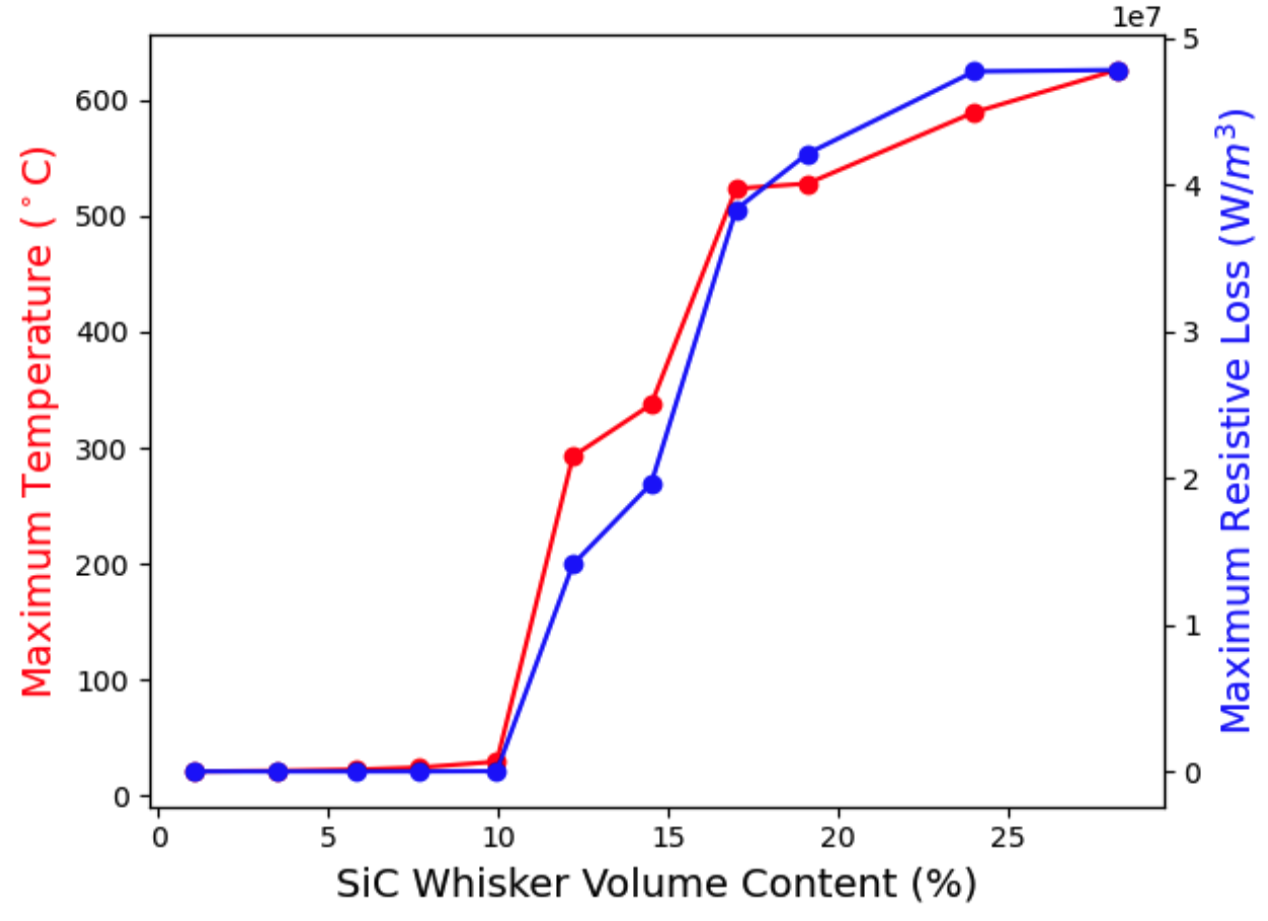
But in the microwave simulations, SiC didn't start dominating the heating behavior until around 17% whisker content, more than twice the percolation threshold. A percolating electrical path isn't enough on its own. You need significantly more SiC before the electromagnetic response flips. That's a non-obvious result, and it matters for anyone trying to design a microwave-active composite from scratch.
On the 3YSZ side: at 2% volume content, it wasn't enough to trigger thermal runaway in the composite, even in samples that reached the temperatures needed to trigger it in pure 3YSZ. But the relationship between electrical conductivity and peak temperature was linear and predictable. There's a tunable lever here. You just need more 3YSZ to pull it.
Processing also turned out to matter more than expected. Samples made with ball-milled alumina were more homogenous, more conductive, and heated more efficiently than samples prepared by hand. How well the whiskers distribute through the matrix directly controls the heating behavior, which is useful to know for anyone trying to scale this up.
The logical next steps are higher 3YSZ loadings to find the critical threshold for thermal runaway in the composite, larger sample geometries for cleaner bulk electrical measurements, and eventually physical microwave heating experiments to validate the simulations.
The longer arc is a heating element you can embed near the lunar surface, power with a solar-charged microwave source, and use to drive water extraction without any direct contact or moving parts. The materials science foundation for that is what this thesis was building toward.